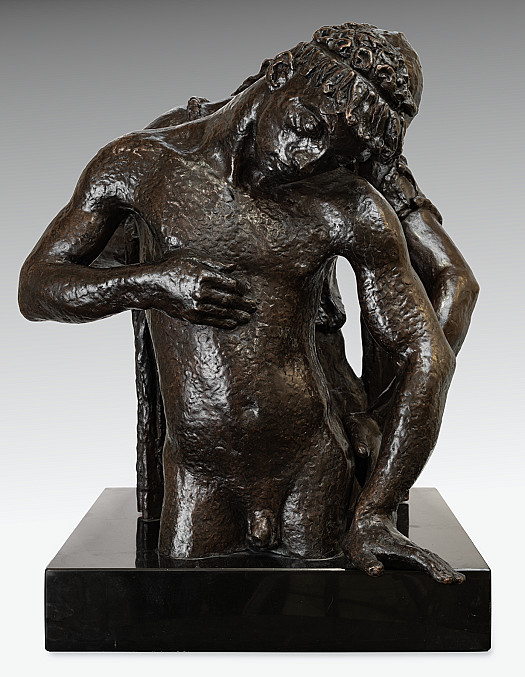
Glyn Philpot was one of the most interesting and ambitious artists working in Britain between the wars. In establishing himself as a painter, he emulated the Old Masters in style and technique, and gained international success, especially as a portraitist. However, he believed that experimentation was essential to artistic development, and essayed a variety of subjects, approaches and materials. This resulted in a small but impressive body of sculptures, and then, more radically, a significant change in his painting towards a decorative modernity.
Glyn Philpot was born in Clapham, London, on 5 October 1884, the youngest of the four surviving children of John Philpot, a surveyor turned commercial traveller, and his first wife, Jessie (née Carpenter). His elder brother, Leonard, would become an architect, interior designer and painter.
Their mother died when Glyn was seven years old, and in 1897 their father married her sister, Julia Carpenter, who had already been a member of the household. By 1901, the family was living at 108 Upper Tulse Hill, Streatham.
Philpot revealed a talent for drawing from early childhood and, at the age 13, he began to produce printed booklets with woodcut illustrations influenced by Charles Ricketts, who would later become a mentor. He left his school in Streatham at the age of 16 as the result of ill health, and was sent to study at the South London Technical Art School, Lambeth, in the belief that the lessons would not tire him. He made rapid progress under Thomas McKeggie and, especially, Philip Connard, and was awarded a scholarship for two years. In 1903, he won first prize for book illustration in the National Competition for Schools of Art; and in 1904, when still only 19, he exhibited at the Royal Academy of Arts for the first time (giving as his address, The Studio, 2A Royal Hospital Road, Chelsea). He spent 1906 studying under Jean-Paul Laurens at the Académie Julian in Paris, and in that year converted to Roman Catholicism, which ‘shocked his Baptist family’ (Oxford Dictionary of National Biography). In a mixed exhibition at the Ballie Gallery, London, in June 1906, he showed his first sculptures.
On his return from Paris, Philpot based himself in Chelsea, and began to establish himself as a painter of portraits and historical subjects in a style and technique that were influenced by Charles Ricketts and Charles Shannon and also the Old Masters who had inspired them. As the result of the success of a number of small exhibitions that he organised, he was able to make trips to Spain in the years 1908-10, and so engage with the work of Velasquez and Goya, among others. It is the example of those artists and of Manet that informed the painting of Le Manuelito (The Circus Boy) (1909, Stedelijk Museum, Amsterdam) and La Zarzarrosa (The Dog Rose) (1910-11, The Fitzwilliam Museum, Cambridge). Along with his first solo show, held at the Baillie Gallery in 1910, these made his reputation when they were exhibited at the Modern Society of Portrait Painters in 1910 and 1911 respectively.
Particularly sought after as a portrait painter, Philpot was elected to the Royal Institute of Oil Painters (1909), helped found the National Portrait Society (1911) and joined the International Society of Painters and Sculptors (1913). He travelled frequently to Paris and in Italy, and visited the United States in 1913 to paint some portraits, including that of Robert Allerton, known as The Man in Black (Tate). While there, he produced a statue for the garden of Allerton’s estate, ‘The Farms’, near Monticello, Illinois. He was also awarded a gold medal at the Carnegie International Exhibition in Pittsburgh for The Marble Worker (1912, Hackley Gallery of Fine Art, Muskegon, MI).
Living in Venice in 1914, Philpot returned to England when war was declared, and attempted to enlist in the army. Rejected several times on medical grounds, he was finally accepted into the Royal Fusiliers in 1915. While attending a training course at Aldershot, he met Vivian Forbes, a fellow soldier and aspiring painter, who would become a close friend and eventually his partner. It was also in 1915 that he was elected an associate of the Royal Academy. However, it was only from 1917, when he was invalided out of the army, that he began to exhibit regularly at its Summer Exhibitions. In 1918, he painted four portraits of admirals for the Imperial War Museum.
Philpot visited Tunisia in 1920, and returned to the United States in 1921, taking Vivian Forbes with him. They stayed in Chicago, where Philpot painted several society ladies, and also with Allerton, on his Illinois estate. Soon after their return to London, Philpot and Forbes began to live together, in the apartment at Lansdowne House, Lansdowne Road, Holland Park, that had been the former home of Ricketts and Shannon (Ricketts seeing them as their artistic successors).
Around this time, Philpot embarked on the most successful period of his career. In the spring of 1923, the Grosvenor Galleries mounted the first retrospective of his work. During its run, he was elected a full Royal Academician, becoming the youngest artist of the day to be so honoured. Late in the year, he travelled to Cairo to paint the portrait of King Fuad I of Egypt, for which he received the generous fee of £3000. Subsequent significant commissions included a portrait of the Prime Minister, Stanley Baldwin (1926), and a mural of Richard I embarking for the Crusades, for St Stephen’s Hall, Westminster (1927). In 1927, he was able to buy a country house, Baynards Manor, near Horsham, in Sussex.
Through the 1920s, Philpot took on a number of official positions. He sat on the jury of the Carnegie International Exhibition, in Pittsburgh, in both 1924 and 1930, and in 1925 became a member of the Royal Society of Portrait Painters and an honorary member of the Royal Institute of Oil Painters. In 1927-34, and again in 1935-37, he was a Trustee of the Tate Gallery. In 1929, he became the first President of the newly formed Guild of Catholic Artists. He was also one of three painters to represent Britain at the Venice Biennale in 1930.
In 1929, Philpot met Henry Thomas, a young Jamaican who was visiting London. He became Philpot’s servant, companion and frequent model for both paintings and sculpture. In so doing, he joined a household that already included Vivian Forbes and Daisy Philpot, one of the artist’s two elder sisters, who acted as his housekeeper and secretary.
Despite his great success, Philpot became dissatisfied with his need to produce work that satisfied the traditional tastes of the artistic establishment. In search of a way to express himself more freely, he travelled to Paris, and engaged with artistic developments happening there. In 1931, he took a studio (previously inhabited by Helena Rubenstein) in the chic Modernist block at 216 Boulevard Raspail, Montparnasse. Initially, he devoted himself to sculpture, while exploring new approaches to painting. The style that emerged was lighter and brighter, and the handling simpler, more direct and more graphic. It was informed by aspects of the art of Pablo Picasso, but also by the more decorative modernity of such as Jean Cocteau and Marie Laurencin. While he was based in Paris, he visited Berlin and was affected by the signs of its Depression. The paintings that resulted from the experience – Lokal, Berlin; Weight-lifting, Berlin; and The Entrance to the Tagada – invite comparison with the satirical qualities of the artists of the Neue Sachlichkeit, Otto Dix and George Grosz. Either in Paris or Berlin, he began a relationship with a young German, Karl Heinz Müller.
Philpot’s new style of painting bewildered both critics and the public, and lost him most of his existing clientele. Nevertheless, he was determined to present his latest work properly, including innovative forays into still life, so, in 1932, he mounted a solo show at the Leicester Galleries. Then, when reviews of it focussed on the influence of Picasso, he reacted by producing some ambitious mythological and religious compositions. Unfortunately, this led to the greatest indignity of his career, when the Council of the Royal Academy asked him to withdraw a major canvas, The Great Pan, from his submissions to the 1933 Summer Exhibition, as a result of its disturbing erotic power. It was given a full-page reproduction in the magazine, Apollo, in June 1933, and the art critic of The Times was positive about it; but, though he featured it in a second solo show at the Leicester Galleries in 1934, he eventually destroyed it. In 1935, he decided to reduce his costs by selling Baynards Manor and moving into a smaller London apartment, at 1 Marlborough Gate House, Lancaster Gate.
In the years 1935-37, Philpot worked frequently in the South of France and North Africa, painting in watercolour. The results were exhibited at two solo shows, at the Syrie Maugham Gallery in 1935 and the Redfern Gallery in 1937, and also helped reinvigorate his oils, ensuring that he produced strong pictures until the end of the career. The strain of four major exhibitions in six years began to affect his health and, on 16 December 1937, he died at home in London of a fatal stroke. Two days after his funeral – at Westminster Cathedral on 22 December – Vivian Forbes committed suicide. A memorial exhibition was held at the Tate Gallery in 1938.
His work is represented in numerous public collections, including the Courtauld Art Gallery, the Imperial War Museums and Tate; the Ashmolean Museum (Oxford), Brighton Museum & Art Gallery, Leeds Art Gallery and the Victoria Art Gallery (Bath).
Further reading:
J G P Delaney, Glyn Philpot: His Life and Art, Aldershot: Ashgate, 1999;
Robin Gibson, Glyn Philpot, 1884–1937: The Bronzes, London: Leighton House, 1986;
Robin Gibson, Glyn Philpot, 1884-1937: Edwardian Aesthete to Thirties Modernist, London: National Portrait Gallery, 1984;
Thomas Lowinsky, revised b J G P Delaney, ‘Philpot, Glyn Warren (1884-1937)’, H C G Matthew and Brian Harrison (eds), Oxford Dictionary of National Biography, Oxford University Press, 2004, https://doi.org/10.1093/ref:odnb/35519;
A C Sewter, Glyn Philpot 1884-1937, London: B T Batsford, 1951