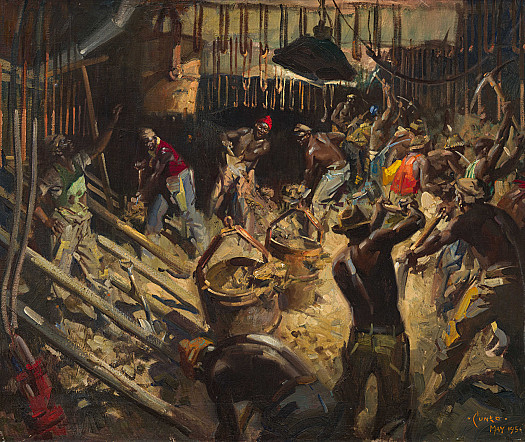
Considered by many to be the greatest railway artist of the twentieth century, Terence Cuneo was a painter and illustrator of highly atmospheric realistic figure scenes – encompassing ceremonial, industrial, military, sporting and wildlife subjects – and also portraits.
Terence Cuneo was born at 215 Uxbridge Road, Shepherd’s Bush, London, on 1 November 1907, the younger son of the painters and illustrators, Cyrus Cuneo and Nell Cuneo (née Tenison). His uncles, Rinaldo Cuneo and Egisto Cuneo, were also painters.
Following the death of his father in 1916, the nine-year-old Cuneo moved with his mother and brother to Holland Park. He was educated at various preparatory schools and then at Sutton Valence School, near Maidstone, Kent. In the early 1920s, his mother settled in St Ives, Cornwall, and bought Down-Along House, which she restored as a home for her and her sons, as a studio for herself, and as a café known as the Copper Kettle.
Inspired by the example of his father, and initially tutored by his mother, Cuneo studied under Percy Hague Jowett at Chelsea Polytechnic, and then at the Slade School of Fine Art. Establishing himself as an illustrator in the late 1920s, he contributed to a range of books and periodicals, and, in 1931, joined the London Sketch Club.
Three years later, he married Catherine Mayfield Monro, the younger daughter of Major Edwin George Monro, a company director; they would have two daughters. In 1940, they moved from 2 Gainsborough Road, Hounslow, to Ember Lane, East Molesey, Surrey.
In 1936, Cuneo started to paint in oils, while continuing to work as an illustrator. In 1939, he illustrated the first of his own books, Sheer Nerve. During the Second World War, he served briefly as a sapper with the Royal Engineers, but spent most of the time as a war artist, for The Illustrated London News (in France in 1940), and then for the Ministry of Information and the War Artists Advisory Committee. His tasks included producing propaganda paintings, anti-Nazi drawings and cartoons, and illustrations of tanks and aircraft factories. He wrote and illustrated, Tanks and How to Draw Them (1943), and held exhibitions of his war work.
Soon after the end of the war, Cuneo began to produce posters for railway companies, and continued to do so for the next 50 years, gaining a great popular reputation for his railway imagery. In 1985, he designed a set of stamps commemorating the 150th anniversary of the Great Western Railway, while his last, unfinished painting was of the Channel Tunnel.
Cuneo painted a number of portraits of the members of the Royal Family engaged in their official duties, beginning in 1950 with King George VI and Queen Elizabeth at the Middle Temple Banquet, depicting the parents of the present Queen. In 1953, he was appointed the official artist for the Coronation of Queen Elizabeth II, an honour that brought him to the attention of an even wider public. He completed the resulting painting in 1955, and it was presented to the Queen by her lords lieutenant. While executing this work, he also produced A Mouse Painting a Still-Life of Cheese, the first of his ‘mouse’ paintings, which led to his practice of including a small and inconspicuous mouse in his more formal works, as a kind of signature. When he published his autobiography in 1977, he titled it The Mouse and His Master.
Cuneo painted a number of other official portraits, including those of the Prime Minister, Edward Heath (1971) and Field Marshal Viscount Montgomery of Alamein (1972).
His activities as a painter took him across the world, and he spent much time in countries in Africa, while also living and riding with cowboys in the United States.
Cuneo held solo shows in London at the galleries of the Royal Society of Painters in Water-Colours (1954 & 1958), at the Sladmore Gallery (1971, 1972 & 1974) and at the Mall Galleries (1988), and also in New York at the Grand Central Gallery (1956).
Cuneo was, at various times, President of the Industrial Painters Group, the Society of Equestrian Artists, the Molesey Arts Society and the Thames Valley Art Society; Vice-President of the Guild of Aviation Artists; Fellow of the Guild of Railway Artists, and a member of the Royal Glasgow Institute of Fine Arts. He was appointed OBE in 1987 and CVO in 1994, and given the Freedom of the City of London in 1992.
Cuneo painted almost to the end of his life and died a millionaire at at Arbrook House, a nursing home in Esher, Surrey, close to his home, on 3 January 1996. He was survived by one his two daughters, his wife having died in 1979. A retrospective, ‘Railway Paintings by Cuneo’, was held at the National Railway Museum, Peterborough, in 1997.
A bronze memorial statue of Cuneo by Philip Jackson, was erected on the main concourse of Waterloo Station, London, in 2004.
Further reading:
Narisa Chakra, Terence Cuneo: Railway Painter of the Century, London: New Cavendish Books, 1990;
Beverley Cole, ‘Cuneo, Terence Tenison (1907-1996)’, H C G Matthew and Brian Harrison (eds), Oxford Dictionary of National Biography, Oxford University Press, 2004, https://doi.org/10.1093/ref:odnb/60751;
Gerald Landy, The Military Paintings of Terence Cuneo, London: New Cavendish Books, 1993