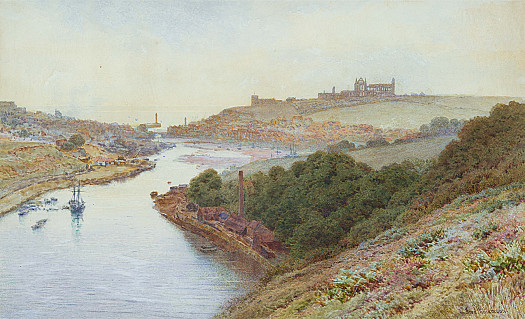
Frederick Williamson was a Victorian landscape painter, best known for his finely executed watercolours and pastoral scenes.
Born in London, he later settled at Farncombe Villas in Godalming, Surrey, from where he developed a successful exhibiting career. He exhibited widely, most notably at the Royal Academy where he showed thirty-seven works between 1864 and 1899.
Frederick Williamson had a particular passion for depicting the English countryside, which he portrayed with great precision. His landscapes, frequently featuring sheep and cattle, are distinguished by their delicate touch, subtle colouring, and close observation of seasonal change. Williamson brought a freshness and variety to this popular subject matter, often being compared to Thomas Sidney Cooper. Although working with established traditions, Williamson’s work remains appealing for its charm, skill, and beautiful reflection of the Victorian countryside. He died in 1900.
His work is represented in the collections of the V&A; the Fitzwilliam Museum (Cambridge), and Colchester and Ipswich Museums.
8 & 10 Ryder Street, St James’s, London SW1Y 6QB
[email protected]
020 7839 7551
© Chris Beetles Ltd 2026 | Accessibility | Privacy | Sitemap