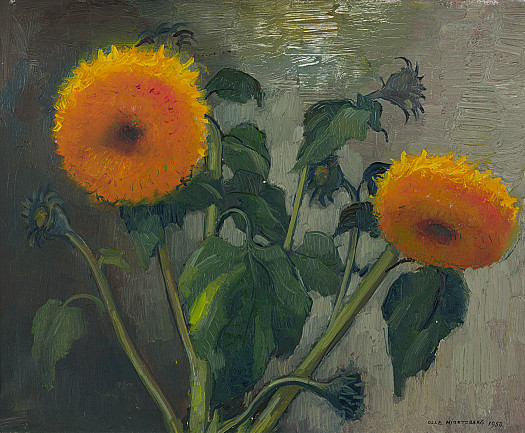
Trained in his native Sweden as an ornamental artist, Olle Hjortzberg travelled extensively across Europe and the Middle East, taking inspiration from visits to Palestine and Syria to enhance his talents as a painter of decorative, brightly coloured still lifes.
Gustaf Olof Hjortzberg was born on 14 November 1872 in Stockholm, Sweden. He was one of seven children of Olof Arvid Hjortzberg, a chief engineer at the Stockholm gasworks, and Maria Henriette (neé Lyon). His father was also an amateur painter and taught watercolour painting to Hjortzberg during his childhood in Linköping, a town in the south of Sweden. In 1886, the family returned to Stockholm, where he was introduced to ornamental artwork and book illustration by his elder sister Annie’s husband, Agi Lindegren, an architect and illustrator. As a teenager, Hjortzberg worked as an assistant in decorative painting for the artist J A G Acke and assisted in the decoration of Uppsala Cathedral.
In 1892, Olle Hjortzberg was accepted into the Royal Swedish Academy of Arts.
During his time there, he received a Royal Medal for academic excellence in recognition of his contributions to decorative projects such as the one he undertook in Uppsala Cathedral.
In 1898, he married Elin Matilda Andersson, the daughter of a merchant, and later that year travelled together to Paris. This marked the beginning of intense travel that would have a profound influence on Hjortzberg’s career. The following year, he travelled to Italy, visiting Florence and Perugia. From Italy, he travelled via Greece to Syria and Palestine, where his interest in ornamental art was further enhanced. He visited London in 1902 before returning to Italy, where he studied in Rome and then Ravenna, taking further inspiration from the city’s Byzantine art. When he returned to Sweden in 1905, his focus turned to religious artwork, designing stained glass windows for the Katarina Church in Stockholm, and a mural for the ceiling of the Klara Church. In 1913, he decorated the Uppenbarelsekyrkan Church in the town of Saltsjöbaden, and also began murals in the Engelbrektskyrkan Church in Stockholm the same year. From 1916, he produced murals for Linköping’s grammar school.
Once settled back in Sweden, Olle Hjortzberg began to find additional success as an illustrator. In 1912, he designed a poster for the Olympic Games in Stockholm and also began designing a series of commemorative stamps depicting national themes during the inter-war period, including a series portraying King Gustaf V of Sweden. His illustrations were also used in periodicals and books, produced as prints, and were also used as the artwork for Nobel Prize for Literature certificates in 1928.
From 1911 to 1937, Olle Hjortzberg held a teaching position at the Royal Swedish Academy. In 1920 he was appointed as the Academy’s Director, a position he held until 1941. Additionally, he taught at the School’s decorative arts programme from 1921 to 1938, and was the Professor of Drawing between 1937 and 1939. In 1945, he was awarded the Prince Eugen Medal, awarded by the King of Sweden for ‘outstanding artistic achievement’.
He died in Stockholm on 8 March 1959, aged 86.
His work is represented in the collections of the Nationalmuseum (Stockholm), the Modern Museum (Stockholm), and the Norrköping Museum.