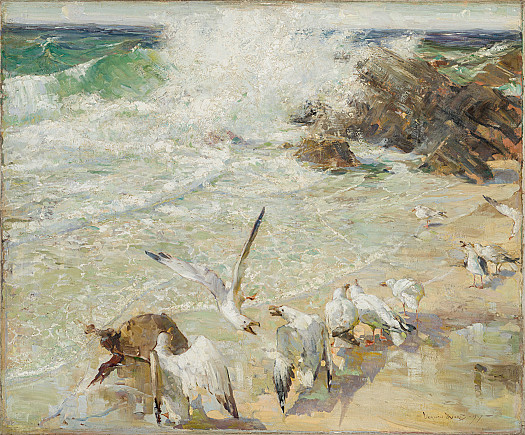
Vernon Beauvoir Ward was an English painter of flowers, birds and gently nostalgic Edwardian subjects, closely associated with Hampstead, where he was born and spent most of his life. The son of an art dealer, Vernon Ward grew up surrounded by paintings and developed an early fascination for copying a wide range of styles. At 14 he entered the Slade School of Art, studying under Henry Tonks, Wilson Steer and Sir Walter Russell.
Following his father’s death, Vernon Ward turned largely to commercial work, producing images that achieved wide circulation through prints, greetings cards, chocolate boxes and puzzles. His preferred subjects such as roses, bird studies and period figures, were handled with a light, decorative touch that appealed to a broad audience.
He exhibited with a number of established societies and was elected a member of the Royal Society of British Artists at a notably young age of 21. During the Second World War, he served with the Civil Defence Service in Richmond, contributed a symbolic composition for the Free French, and later designed a naval memorial for Twickenham. He occasionally worked under the pseudonym ‘Bertram Linder’.
Vernon Ward travelled and sketched extensively, particularly in the Lake District, and continued to paint despite significant physical challenges, including loss of sight in one eye and later, severe arthritis. His first solo exhibition was held in 1976. Vernon Ward died in 1985, leaving a substantial and widely reproduced body of work that has retained its quiet appeal.
8 & 10 Ryder Street, St James’s, London SW1Y 6QB
gallery@chrisbeetles.com
020 7839 7551
© Chris Beetles Ltd 2026 | Accessibility | Privacy | Sitemap