AUTUMN EVENING
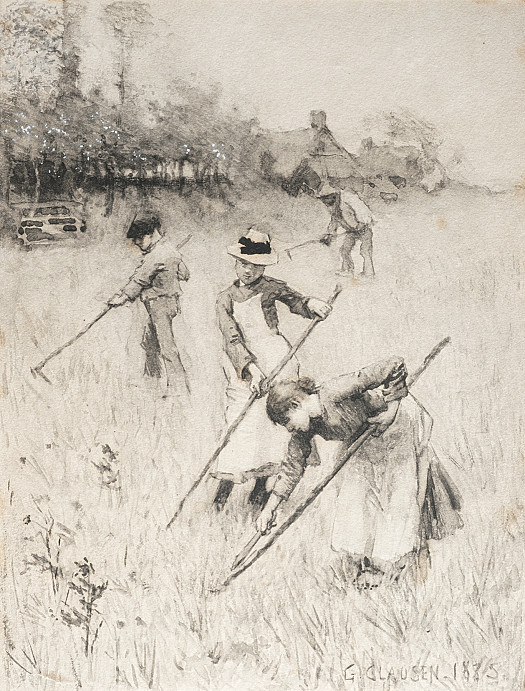
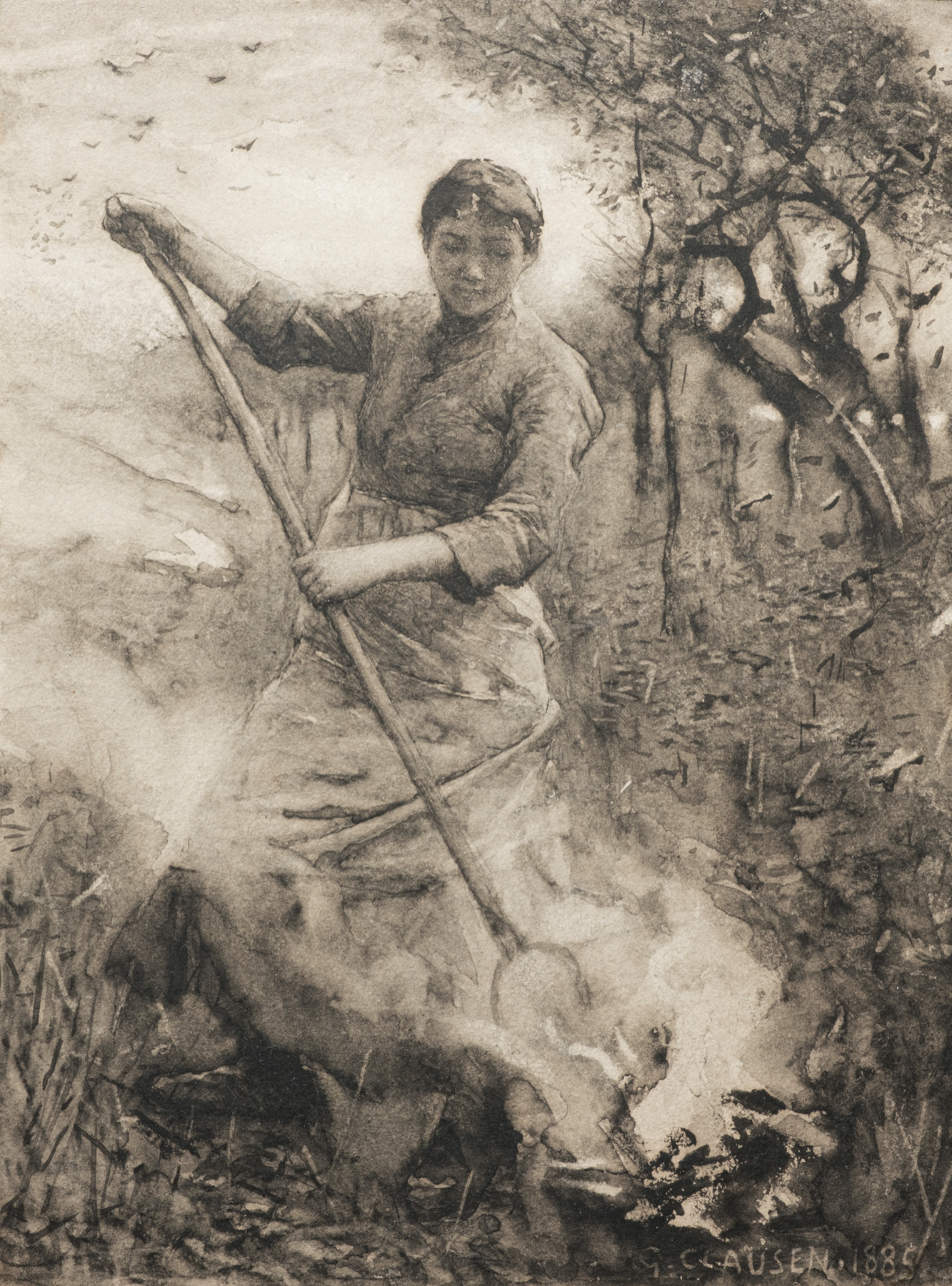
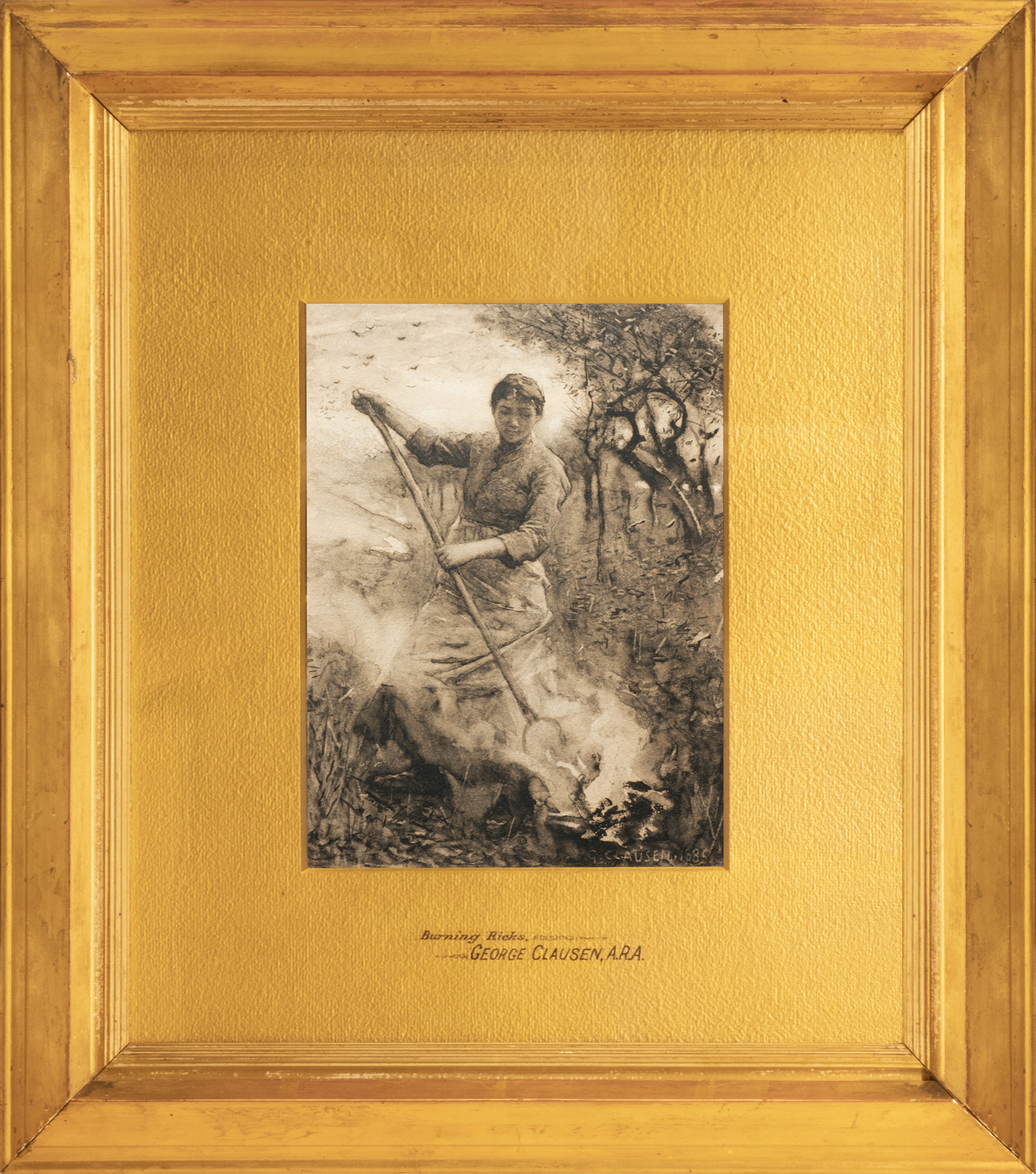
Of the 'Seasons' series illustrations all contain children, save for Autumn Evening in which a woman tends her smoky fire at the edge of a field.
She is burning weeds, dead leaves and other debris that litter the land after the October storms - one of a series of tasks performed in the waning of the year that included stone-picking, thinning the copses, and cutting woodland ferns to be used as bedding for animals. If the social and economic context of these humble activities was clear to the urban middle classes, the rich artistic legacy upon which the artist drew, was less obvious.
While he approved the utopian Socialism of William Morris, Clausen was acutely aware of the rural themes that had recently emerged in British art. He had seen the heroism of Fred Walker's Vagrants, (1868), reduced to saccharin sweetness in the work of Myles Birket Foster. Travelling in France and the Low Countries in the 1870s, he became aware of Jean-François Millet's and Jules Breton's vie rustique and realised that their bucolic subjects were being reworked by artists of his own generation whose robust documentary realism was raising eyebrows in the Salons. Following the publication of the English language version of Millet's biography these seeds were blown across the channel. However, xenophobia was laced with a false consciousness of country life in which its hardships were fashioned into a rural arcadia by many of Clausen's contemporaries and hostility to his work in important exhibitions focussed upon his close association with the rural Naturalism of his French contemporany Jules Bastien-Lepage.
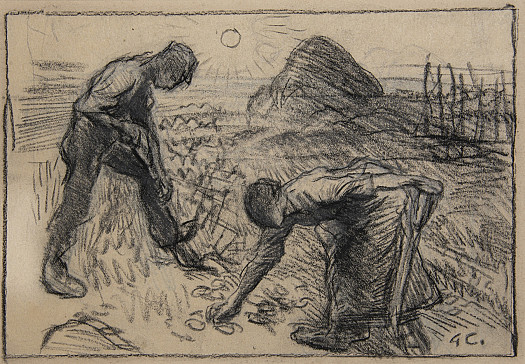
Clausen's woman with a hoe in Autumn Evening cuts a more dramatic profile than the faneuses of Millet and Bastien-Lepage. She energetically rakes the fire and in doing so is enveloped in smoke, like the woman in Walker’s Vagrants. In so doing she emphasises the role women and their offspring were obliged to play the rural economy - themes that featured in the Summer.. and Winter Songs and Sketches.
If the productivity of the land depended upon seasonal change, so too did the secrets of its husbandry rely on one generation passing them to the next. There is thus a complex play of ideas and images in Clausen's contributions to RE Mack's enterprise.
The contact was an important one, since it led not only to a number of Clausen's own poems being reproduced in other later 'Songs and Sketches’ booklets edited by Nesbit and Mack, but also to the involvement of Agnes Mary Clausen, the artist's wife, whose volume of verses, Daisy Days, appeared in 1887. Marketed at 1s 6d, as a 'good substitute' for Christmas cards in December 1886, the 'Seasons' series moved Clausen into a realm of popular imagery. The consciousness of his work might not be greatly increased as a result but its engagement with the tropes of rurality and their dissemination to a wider audience is not without significance. The recovery of two works from this important sequence is thus, a cause for celebration.
8 & 10 Ryder Street, St James’s, London SW1Y 6QB
gallery@chrisbeetles.com
020 7839 7551
© Chris Beetles Ltd 2026 | Accessibility | Privacy | Sitemap