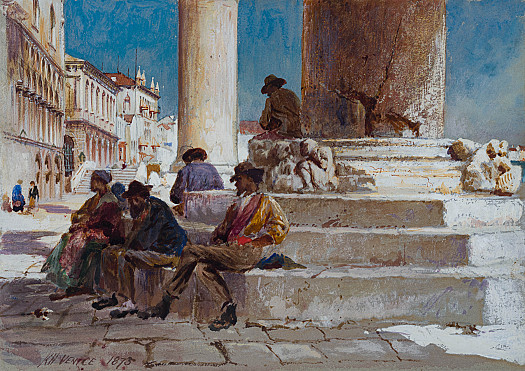
John Keeley Halswelle was born on 23 April 1831 in Richmond, Surrey. The son of David Halswelle, a merchant, he grew up in middle class family which allowed for some level of education and artistic training. From an early age, Keeley Halswelle showed a talent for drawing. Rather than entering a traditional academic or university education, he pursued art directly. His first professional steps were in London, where he worked as a draughtsman and illustrator, contributing to The Illustrated London News, the world's first illustrated weekly news magazine.
This work required speed and high accuracy, which effectively served as his artistic training.
This brought him into contact with publishers in Edinburgh, such as William Nelson, one of the leading figures in Victorian publishing, producing images for publications of major classic literary figures such as Byron, Scott and Wordsworth. Keeley Halswelle spent a period living and working there, which helped establish his reputation during the 1850s and early 1860s. By 1863 he was residing at Bellfield House in Duddingston, then a semi-rural area just outside the city.
It was also in Edinburgh that Halswelle began to shift from illustration to painting in the late 1850s. He exhibited at the Royal Scottish Academy, starting in 1857, and was elected an Associate of the Academy in 1865. This institutional recognition marked his emergence as a serious painter, rather than solely a commercial illustrator.
After his brief first marriage ended, he married his second wife Maria Browne in 1861, the daughter of James Browne, an Edinburgh advocate. A significant turning point came with their move to Italy in 1869 for the majority of their marriage, where he spent several years painting continental scenes. His early paintings were largely figurative, often with literary or historical narratives. Maria died in 1873.
Upon his return from Italy in 1873, Keeley Halswelle married Helen Gordon, a daughter of a British Army major-general. The couple had two sons, one of them Wyndham Halswelle, who would later become a notable British athlete and Olympian.
After his return to London, Keeley Halswelle increasingly focused on landscape painting, particularly scenes of the River Thames – the works he is best known for today. His inspiration was mainly drawn from life as he spent several years aboard a houseboat, the Kelpie, which he used as a floating studio, allowing him to paint river scenes at first hand. This later resulted in publishing the book Six Years in a Houseboat (1883).
At the same time in 1880, Halswelle established a more permanent base at Stoner House in Steep, Hampshire. From here, he continued to travel and maintain connections with London’s art world. His Thames paintings and plein air sketches were widely exhibited in London, many of which have ended up in notable collections such as the V&A and the National Gallery. In 1882 he was elected a member of the Institute of Painters in Oil Colours, marking formal recognition by his peers.
Keeley Halswelle died in Paris on 11 April 1891, from pneumonia, and was buried on 20 April 1891 in Steep, Hampshire.