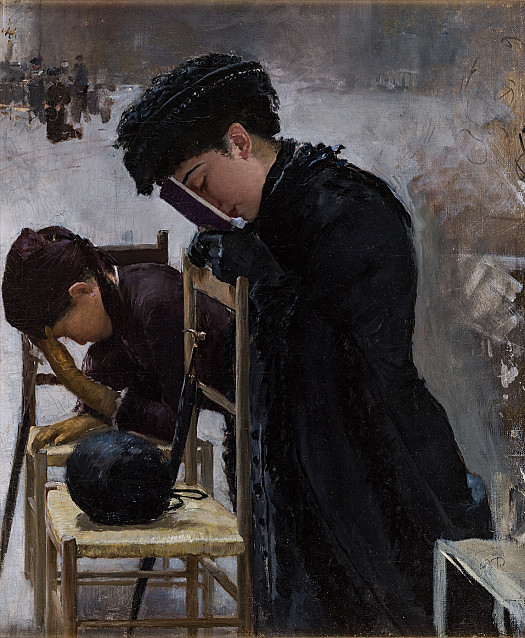
A graduate of the Swedish Royal Academy of Fine Arts, Georg Pauli was a notable member of a community of Scandinavian artists based in the artistic French village of Grez-sur-Loing. Together with contemporaries such as Peder Krøyer, Julia Beck, and his wife, Hanna Hirsch, Pauli embraced the influences of French Naturalism to become one of the most significant and celebrated Swedish artists of the period.
Georg Vilhelm Pauli was born on 2 July 1855 in Jönköping, Sweden, a small town on the shores of Lake Vättern, east of Gothenburg. Descended from a noble Italian family, he was the fourth of six children of August Ferdinand Pauli, an apothecary and manufacturer, and Maria Laurentia Augusta (neé Gagner). From 1871 to 1875, Georg Pauli studied at the Royal Swedish Academy of Fine Arts, and spending two years travelling in France and Italy, before completing his studies at the Academy from 1878 to 1879.
Returning to France in 1879, George Pauli settled in the village of Grez-sur-Loing, south-west of Paris, where a burgeoning artistic community had grown. The community included a number of significant Scandinavian artists, such as Carl Larsson, August Strindberg, Peder Krøyer and Julia Beck, who had been a contemporary of Pauli’s at the Academy.
At Grez-sur-Loing, he also met the Swedish artist Hanna Hirsch. They married in 1887 and together would have three children, Torsten (born 1889), Göran (born 1891) and Ruth Emerentia (born 1896).
From the late 1870s, Georg Pauli attended the Académie Julien in Paris, where he was strongly influenced by the work of the French Naturalists, including Jules Bastien-Lepage. In 1885, he exhibited the painting La collation des Paysans a la recolte du Colza, Calvados, at the Paris Salon, for which he received an honourable mention. He would exhibit there again in 1889 and 1890. After he and Hanna Hirsch married, they spent time travelling in Italy, where Pauli was exposed to Italian fresco painting, which became an inspiration to his work on his return to Sweden. In 1905, Georg Pauli moved with his family to the town of Storängen, south-east of Stockholm, settling in a manor house and studio they called ‘Villa Pauli’. Back home, Georg Pauli taught at the Våland Academy in Gothenburg, and was commissioned to paint many frescoes in various public buildings, including the East India House (now home to the Museum of Gothenburg), Stockholm City Hall and the Royal Dramatic Theatre, as well as in secondary schools in Stockholm and his home town of Jönköping.
In 1911, Pauli returned to Paris for a time, where he worked with the French painter André Lhote, developing an interest in Cubism, which would manifest itself in some of his later fresco and mural work.
In addition to his work as an artist, Georg Pauli also developed a reputation as a talented author of historical and biographical works, including biographies of fellow artist Ernst Josephson (1903 & 1914), Konstnärsliv och om konst (Artist’s Life and About Art) (1913), I Paris, nya konstens källa (In Paris, the source of new art) (1915), Väggmåleri (Mural Painting) (1920) and Prins Eugen (1925). He also wrote about his own travels in En Målares resa (A Painter’s Journey) (1922). From 1917 to 1921, he published the art journal, Flamman. He died on 28 November 1935 in Stockholm.