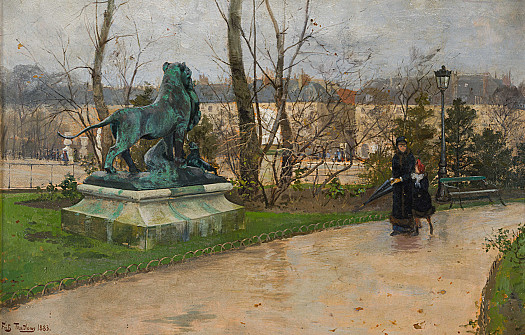
Alongside contemporaries such as Michael Ancher, P S Krøyer and Christian Krohg, Frits Thaulow is considered to be one of the finest and most important of the Scandinavian proponents of Naturalism.
Johan Frederik Thaulow was born on 20 October 1847 in Christiana, Norway, one of nine children of a wealthy pharmacist, Harald Conrad Thaulow, and Nicoline Louise (neé Munch). As a young man, he honoured his father’s wishes to follow a traditional, academic education. He had also shown a passion and talent for painting and in 1870 at the age of 23, enrolled at the Academy of Art in Copenhagen. There, he studied under the marine painter Carl Frederik Sørensen. He left Copenhagen in 1872 and the following year he travelled to Germany, where he studied at the Baden School of Art in Karlsruhe.
There, he was influenced by the Norwegian marine and landscape artist Hans Gude. In 1874, he married Ingeborg Charlotte Gad, whose sister had married the French painter Paul Gauguin the year before. Together, they would have two children, before their marriage ended in 1886. Between 1875 and 1879, Frits Thaulow settled in Paris, where he immersed himself in artistic the community, and exhibited at the Salon des Artistes Français.
In 1879, along with his friend and fellow artist Christian Krohg, Frits Thaulow travelled in a small boat to the fishing village of Skagen in the far north of Jutland. From the early 1870s, an artist community had developed in Skagen, started by artists such as P S Krøyer, Michael Ancher and Viggo Johansen. These artists had grown tired of the rigid teachings of Neoclassicism and Historicism by establishments such as the Royal Swedish and Danish Academies. Instead, they chose to embrace the trends of Naturalism, and were attracted by the area’s peaceful, coastal scenery and quality of the light. As Thaulow had been exposed to the fashions of Naturalism and influence of artists such as Jules Bastien-Lepage while in Paris, Skagen greatly appealed to him, and his work would be inspired by and associated with the Skagen Colony for the rest of his career.
Thaulow returned to Norway in 1880, and in 1882 he helped organise Norway’s first National Art Exhibit (also known as the Autumn Exhibit or Høstutstillingen), along with Krohg and Erik Werenskiold. Held in Oslo, this exhibition was seen as a radical protest to the established dominance of the Christiana Art Society. Thaulow would spend the next decade in Norway, during which time he would establish himself as a leading proponent of the new wave of Scandinavian Naturalism. He made several visits to Paris during this period, exhibiting at the Universal Exhibition in 1889, where his work was noted by Monet and Rodin, and at the Salon du Champ-de-Mars the following year. He also made several trips to Venice, producing many drawings and paintings of the city. In 1890, he exhibited at the Munich Salon, where he was awarded a Gold Medal.
In 1892, Frits Thaulow returned permanently to France, initially in Paris, but he soon moved out of the city, instead preferring to live and work in smaller French villages, where the many rivers and waterways were often a main element of his work. He spent time in Montreuil-sur-Mer in northern France between 1892 and 1894, in Dieppe between 1894 and 1898, and in Quimperle, Brittany and Beaulieu-sur-Dordogne from 1901. Thaulow and his second wife, Alexandra Lasson, whom he had married in 1886, socialised regularly in the artistic communities that had evolved in rural France in this period. They became acquainted with visitors to the region such as Charles Conder and Aubrey Beardsley, and Thaulow developed a friendship with Claude Monet, whom he had first met in Paris. The two would often paint en plein air together. His work continued to be exhibited widely during this period. He was awarded a Gold Medal at the Vienna Salon in 1894 and won the Great Prize of Paris during the 1900 Universal Exhibition.
In addition to the individual awards and medals for his artwork, Frits Thaulow was recognised across Europe with numerous personal awards. He was appointed Commander of the 2nd Royal Norwegian Order of St Olav in 1905 and received the French Legion of Honor (Knight in 1889, Officer in 1901). He was also awarded the Order of Saints Maurice and Lazarus in Italy, and the Order of Nichan Iftikhar in Tunisia.
In 1897, Thaulow developed diabetes and over the next nine years his condition worsened. He died on 5 November 1906, aged 59.
His work is represented in the collections of the National Museum of Norway (Oslo), Hermitage Museum (St Petersburg); and the Museum of Fine Arts (Boston, MA), and the Busch-Reisinger Museum (Harvard, MA).