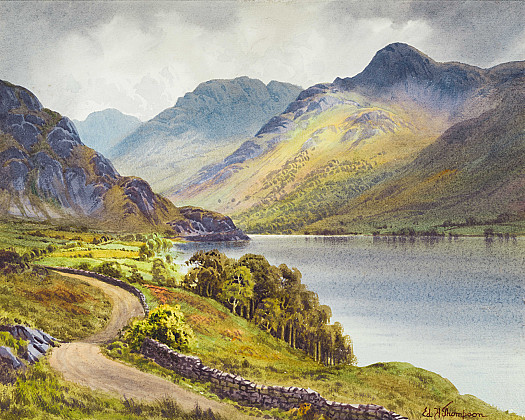
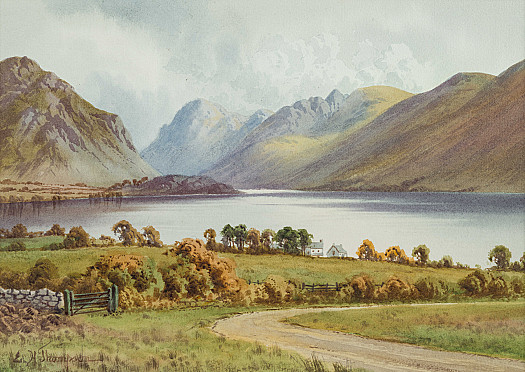
Edward Horace Thompson was a Cumbrian artist who specialised in producing striking, yet delicately rendered watercolours of his native Lake District.
Edward Horace Thompson was born on 28 January 1879 in Seaton, Workington, the youngest of five children of Henry Thompson, a steelworks engineer, and Betsy (née Chester). The family lived at 47 Gray Street in Workington, and as a boy, Edward Thompson was enrolled at the local school, which he attended until the age of 14. He had become enamoured with painting as a child, and though his parents encouraged his interest, they were reluctant to allow him to pursue a career as an artist and instead urged him to learn a trade. After leaving school, Thompson took a job as a clerk at what was then known as the ‘Combine’ in Workington, and would in 1909 become the Workington Iron and Steel Company.
In 1902, aged 23, he married Sarah ‘Sally’ Mary Armstrong at St Michael’s Church in Workington. Their first child, Dorothy, was born in 1909 and the following year the family moved from Thompson’s family home in Gray Street to Elizabeth Street in Workington.
In 1912, their second daughter, Marjorie, was born and the family moved again the following year, to 24 Mayo Street in Cockermouth. Their only son, John, was born there in 1914, before their final child, Mary, was born in 1916. During this time, Edward Thompson had only been painting in his spare time, whilst continuing to work as a clerk. He preferred painting landscapes and seascapes of the Lake District and its coastline and sold his works regularly, particularly through friends and colleagues at his work.
Upon the outbreak of the First World War, due to a combination of his age and the importance to the war effort of workers in the steel industry, Thompson was not called up for military service. However, he was required to work longer hours, and once the war had ended in 1918, he decided to give up his job to become a full-time artist. He moved his family to the village of Eaglesfield. He opened a studio in Cockermouth, where in addition to painting, he began giving lessons to classes of students. Around 1924, he started signing some of his works using the pseudonym ‘Donald Paton’, possibly to improve his sales in Scotland through a visiting London dealer.
After Thompson and his family moved in 1926 to the hamlet of Routenbeck, near Bassenthwaite, he gave up his Cockermouth studio and began to work from home. He continued to sell many of his paintings through contacts he had kept at his old company, whilst also selling paintings to a number of inns and public houses in the area. They moved a final time in 1928 to the hamlet of Ruddings, where Thompson created a studio and entered the most prolific period of his career, producing large numbers of paintings and transporting them by bus or bicycle to various dealers and public houses in the area. His frequent trips to pubs and inns had an adverse effect on his health however, as he began to drink heavily, straining his relationship with his family.
Edward Thompson’s successful output during the late 1920s and early 1930s brought him to the attention to the popular publishers of postcards, Valentines of Dundee. He began painting views of the Lake District for them from the 1930s, and by the 1940s a number of these images were being reproduced in booklets and calendars. By 1939, his youngest daughter, Mary, married and left the family home, leaving Thompson and his wife Sally living alone. From 1940, Sally Thompson’s health was deteriorating, suffering a stroke and losing her ability to speak. In 1943, the Thompsons suffered the tragedy of the death of their son John in an accident while awaiting deployment to the front lines from Stranraer. In 1947, Sally Thompson died. Edward Thompson himself died on 23 December 1949 at Keswick Cottage Hospital at the age of 70.
In 2023, a biography of Edward Horace Thompson, The Lake District’s Most Prolific Painter, by Charles Nugent, with a forward by Glen James, was published.